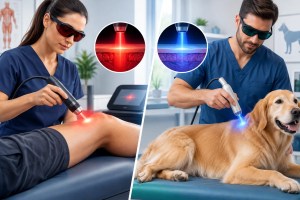
A laser’s class can shape far more than a specification sheet. For practices comparing Class IV versus Class III therapeutic lasers, the practical questions are about treatment delivery, staff workflow, safety procedures, patient comfort, and whether the platform supports the clinical model the practice intends to build.
The most useful starting point is this: laser classification describes potential hazard based primarily on accessible output power. It does not independently determine clinical value, treatment quality, or the appropriateness of a system for a particular patient population. A thoughtful purchase decision requires clinicians to look beyond class designation and evaluate how power, wavelength, delivery method, protocols, training, and support work together.
Class IV Versus Class III: The Core Difference
In the United States, therapeutic lasers commonly discussed in clinical settings generally fall into Class IIIb or Class IV categories. Class IIIb systems typically operate above 5 milliwatts and up to 500 milliwatts of accessible emission. Class IV systems operate above 500 milliwatts.
That difference in output power affects the rate at which energy can be delivered to tissue. A higher-power system can generally deliver a prescribed amount of energy over a larger area or in less time than a lower-power system, provided the clinician uses appropriate settings and technique. It may also produce a more noticeable warming sensation during treatment, depending on the protocol, tissue target, applicator movement, skin characteristics, and duration.
Neither classification should be treated as a shortcut for clinical decision-making. A Class IIIb laser may fit a practice that prioritizes lower-output applications, smaller treatment areas, or certain workflow preferences. A Class IV platform may be better aligned with providers who need to address larger anatomical regions efficiently or who want a higher-capacity system integrated into a busy treatment schedule. The appropriate choice depends on the practice, not simply the number on the device label.
Why Power Changes Workflow
For clinicians, output power becomes meaningful when it changes the treatment experience and the operational model. If a protocol calls for a certain energy dose over a large area, a lower-output device may require a longer application time. That can be entirely workable in a low-volume setting or when laser is used as one component of an extended treatment visit.
In a sports medicine clinic, chiropractic office, physical medicine practice, or veterinary facility with frequent musculoskeletal cases, treatment time may carry more weight. A higher-output Class IV system can support shorter delivery times for comparable energy targets, allowing the provider or trained staff member to incorporate laser sessions into a more predictable schedule.
This is also where real-world implementation matters. A device that looks capable on paper but has no clear protocol structure can create inconsistency between providers and staff. Conversely, a platform with guided workflows can help standardize setup, treatment area selection, and parameter choices while preserving the clinician’s judgment.
Diowave’s Stealth Micro-Pulsed Technology and physician-developed AI treatment software are designed around this operational need: helping providers apply clinically informed treatment workflows without turning each session into a prolonged manual calculation exercise. Technology should support clinical consistency, not add another layer of complexity to the day.
Wavelength and Delivery Matter as Much as Class
Power alone does not describe how a therapeutic laser performs in practice. Wavelength, beam profile, pulsing strategy, applicator design, contact technique, and treatment area all influence the delivery approach.
For example, 810 nm wavelength technology is commonly used in therapeutic laser systems because it is within the near-infrared range and is suited to applications involving topical heating and local circulation. Diowave systems are FDA-cleared as infrared lamps intended to provide topical heating for the temporary relief of minor muscle and joint pain, muscle spasms, stiffness associated with minor arthritis, relaxation of muscle tissue, and temporary increases in local circulation.
A provider evaluating a Class IV or Class IIIb device should ask how the system helps translate its technical specifications into a repeatable clinical process. Does it offer protocols appropriate to the practice’s primary patient presentations? Can staff quickly identify the treatment area and select an appropriate workflow? Is the applicator comfortable to use over large regions? Is the system portable when treatment is delivered across multiple rooms, sidelines, barns, or equine facilities?
These questions often reveal more about day-to-day fit than a comparison based on wattage alone.
Thermal Considerations and Treatment Technique
Class IV systems can deliver energy at a higher rate, which makes technique particularly important. The provider must account for patient feedback, tissue depth, skin sensitivity, treatment area, pigmentation, hair or coat characteristics in veterinary applications, and the movement of the applicator. Continuous motion and clinically appropriate settings can help manage the thermal experience during treatment.
A higher-output laser is not automatically the right choice for every anatomical region or every patient. Smaller, more sensitive, or superficial areas may call for adjustments in power, duration, movement, or pulsing. The ability to tailor delivery is a clinical advantage when it is paired with appropriate training.
Class IIIb systems may present a different treatment profile because of their lower power range. They can still require careful protocol selection and eye safety procedures, but their lower output may be preferred by clinicians whose treatment model does not require rapid energy delivery over broad regions.
The key is not to view thermal response as a flaw or a benefit in isolation. It is a treatment variable that must be understood, monitored, and managed. Practices should select equipment from a manufacturer that provides direct education on proper operation, treatment technique, contraindications, safety procedures, and workflow integration.
Safety Requirements Are Not Optional
Both Class IIIb and Class IV therapeutic lasers require professional safety practices. Because these devices can present an eye hazard, providers, staff, and individuals in the controlled treatment area should use wavelength-appropriate protective eyewear. Practices should also establish clear room procedures, post appropriate signage, control access during treatment, and train every team member who may operate or assist with the system.
Class IV devices typically demand even greater attention to these controls because of their higher output. That does not make them impractical. It means the practice needs an implementation plan that includes staff education, documented operating procedures, and accountability for consistent use.
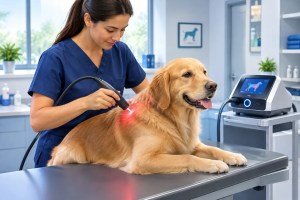
Veterinary and equine providers should consider the additional realities of animal movement, handler positioning, coat density, and treatment environments outside a conventional clinic. A portable laser may be valuable in these settings, but portability should never reduce the rigor of the safety process.
Evaluating the Business Case for Each Platform
The clinical decision and the business decision are connected. A laser system may support a private-pay service offering, but only when the practice has a clear plan for scheduling, staff roles, patient communication, documentation, and follow-up.
Before selecting a laser class, practice owners should evaluate several practical factors:
- The types of musculoskeletal presentations and treatment areas seen most often
- The volume of visits and the amount of time available per laser session
- Whether treatments will be provider-delivered, delegated to trained staff, or both
- The need for portability across rooms, facilities, sporting events, or veterinary calls
- The quality of initial training, clinical resources, and long-term implementation support
A lower-cost device can become expensive if it sits unused because staff lack confidence or treatments take too long to fit the schedule. Likewise, a higher-power system may not produce its full operational value if the practice has not defined its protocols, pricing, and patient flow.
For many practices, the most durable investment is not simply a Class IV or Class IIIb laser. It is a complete implementation relationship that includes clinically grounded education, practical workflow guidance, and support after the initial purchase.
The Better Question to Ask
Rather than asking which laser class is universally better, ask what level of power delivery, protocol guidance, portability, and clinical support will help your team deliver care consistently. Class IV and Class IIIb systems each have a place in professional practice. The right platform is the one that fits the populations you serve, the treatment experience you want to provide, and the workflow your team can sustain.
When a practice evaluates laser technology through that lens, the conversation moves beyond watts and classifications and toward a more useful goal: building a non-invasive treatment option that clinicians can implement confidently and patients can understand.